The Research Step Most Writers Skip Before Drafting
There's a moment every writer knows. You've got the assignment, the idea is hot, and the cursor is blinking. So you start typing.
That instinct — write first, sort it out later — is exactly where a lot of good pieces quietly go wrong. Not because the writing is bad, but because it was done half-informed. The most commonly skipped step in the writing process isn't editing or outlining. It's the research you do before you draft: figuring out what's already been said about your topic, and where the conversation actually stands.
This guide is about that one step — why writers skip it, what it costs them, and how to do it in about a minute instead of losing an afternoon to open browser tabs.
Why writers skip pre-writing research
The reasons are understandable, and they're mostly about momentum.
The first is enthusiasm. When you land a topic you care about, the urge is to sit down and write immediately — capturing the energy while it's there. Stopping to research feels like it kills the spark. Writing coaches see this constantly: writers get excited and dive straight in, and the work ends up "at best only half-informed," according to AWAI's breakdown of the writing process.
The second is fear of the rabbit hole. Research never truly finishes — there's always one more source, one more tab. Writers who've been burned by that know it can turn into infinite postponement, so they skip it entirely rather than risk never starting. That's a real tradeoff, but the fix isn't skipping research; it's bounding it.
The third is that it feels optional. Drafting produces visible output — words on a page. Research produces nothing you can point to. So under deadline pressure, it's the first thing to get cut.
What skipping it actually costs
Skipping the research step doesn't announce itself. It shows up later, disguised as other problems.
The most common is the muddled first draft. When you don't know what's already out there, you write into a vacuum — restating things that have been said a hundred times, missing the angle that would have made your piece stand out, and burying your real point somewhere in paragraph nine. That draft then needs heavy revision to rescue it, which is slower and more painful than the research would have been.
There's also "dead-ending" — the piece that starts strong and then spirals out of control because there was never a clear line of development. And there's plain writer's block, which often isn't a creativity problem at all. It's an information problem: you're stuck because you don't yet know enough to have something to say.
The research backs this up. Writing-pedagogy studies consistently find that people taught to treat writing as a process — with a real prewriting stage — produce more coherent, higher-quality work than those who just draft and submit. Grammarly's overview of prewriting notes that even 15–30 minutes of upfront exploration improves clarity and cuts revision time. The upfront cost is small; the downstream savings are large.
The core trade: research before writing feels like it slows you down. In practice it speeds you up, because a draft written toward the existing conversation needs far less rescuing than one written blind.
The step, stated simply: map the conversation first
Here's the habit worth building. Before you write an article, spend a few minutes answering one question: what's already being said about this topic, and by whom?
Not "what do I want to say" — you'll get to that. First, what's the surrounding conversation? This does three things for you at once:
It shows you the consensus — the points everyone already makes, so you don't waste your piece re-establishing them. It shows you the gaps — the angles nobody's covered well, which is where your piece earns its place. And it shows you the disagreements — the tensions and counterarguments you'll need to address to be taken seriously.
This is what content strategists formalize as a content gap analysis: looking at what's already ranking for your topic and finding what's absent, thin, or outdated. But you don't need to be doing SEO to benefit from it. Any writer — essayist, newsletter author, journalist, student — writes a better piece when they've seen the landscape first. As Semrush's guide to content research puts it, you take your main topic, look at the top results, and read for what they're missing.
The manual way (and why it stalls)
You can absolutely do this by hand, and it's worth understanding the manual version so you know what you're speeding up.
The manual workflow looks like this: pull out the core ideas in your draft or brief, search each one on Google, open the top handful of results for each, skim them, and keep notes — usually in a doc or spreadsheet — on what each source says and which sources keep reappearing. The URLs that surface across multiple of your topics are the load-bearing pieces of the conversation; those are the ones worth reading closely.
Done well, this is genuinely valuable. Done under deadline, it's exactly the step that gets skipped — because it's a dozen searches, forty open tabs, and a spreadsheet nobody wants to start. The value is real; the friction is what kills it. One writer's guide to organizing research is largely about taming that sprawl, which tells you how much sprawl there is.
The trick to keeping it bounded: treat it as a scan, not a literature review. You're mapping the terrain, not memorizing it. Fifteen minutes, a handful of sources per idea, then stop.
Making the step take a minute instead of an afternoon
This scan-the-conversation step is exactly what BeingSaid was built to collapse. Instead of running a dozen searches yourself, you paste in your draft, notes, or brief. It pulls out the core concepts in the text, searches the web for each one, and ranks the results by how many of your concepts surfaced them — so the pieces at the top are the ones sitting at the center of your topic's conversation.
In other words: it does the manual scan above, automatically, and hands you the map. You get the recurring sources, the surrounding reading, and a sense of where the conversation clusters — the raw material for spotting the consensus, the gaps, and the counterarguments you'll want to address — in about the time it takes to read this paragraph.
A note on how it works, because it matters: BeingSaid shows you its own extracted concepts and links you out to the source articles. It doesn't reproduce or republish anyone's content — it points you to it. The reading is yours to do; the tool just makes sure you're pointed at the right things.
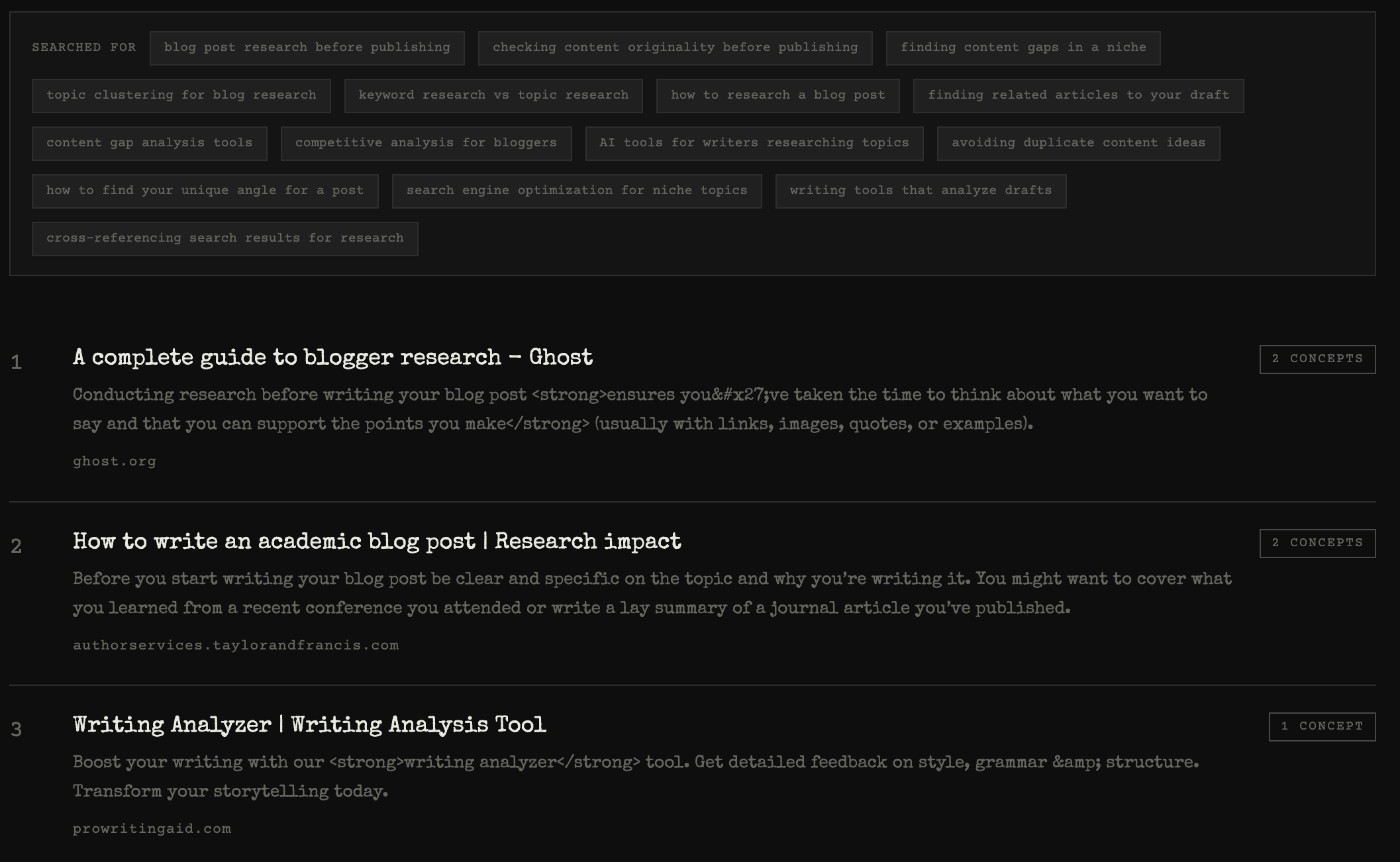
Try it on your next piece. Paste in the draft or brief you're about to write and see what's already being said about it. Try it free — 5 searches, no card. Run your first search →
Build it into your process
The goal isn't to add a heavyweight research phase to everything you write. It's to make "map the conversation first" a reflex — the same way you'd never send an email without reading it back.
A simple rule of thumb: before you write the first sentence of anything longer than a paragraph, spend a few minutes seeing what's already out there. Note the consensus so you can skip it, the gaps so you can aim at them, and the disagreements so you can meet them. Then draft — faster and clearer, because you're writing toward a conversation instead of into a void.
If you want the fuller picture of this workflow, start with our pillar guide, How to Find Out What's Already Been Written About Your Topic, which walks through the whole approach end to end. And when you're ready to turn a specific draft into a competitive scan, content gap analysis is the next step.
The writers who consistently produce sharp, well-placed work aren't necessarily faster typists. They just don't skip this step.
BeingSaid turns any draft into a map of what's already being said about it — paste your text, get ranked, relevant sources. Try it free — 5 searches, no card.