Content Gap Analysis: How to Find What Everyone Else Is Saying (and What They're Missing)
You have a draft, a brief, or a topic you're about to commit a week to. Before you write it, you want two things: a map of what everyone else has already said, and a clear read on what they've missed. That second half is the whole game. What everyone says is your competition; what nobody says is your post.
That's what a content gap analysis gives you. It's the workflow content strategists use to compare the conversation that already exists on a topic against the piece you're planning — so you can stop rehashing the top ten results and start writing the thing they're all missing. This guide walks through the full manual process, explains why it changed in 2026, and shows how BeingSaid collapses the slowest part of it into one paste-and-run.
What is a content gap analysis?
A content gap analysis is the process of auditing the content that already exists on a topic — yours and everyone else's — to find where coverage is missing, thin, outdated, or too similar to what's already ranking. The output is a shortlist of gaps: questions readers are asking that nobody has answered well, angles competitors have ignored, and formats or depth the existing pages don't offer.
Most people think of it as a keyword exercise, but that framing is out of date. A gap isn't just a keyword you don't rank for. As Semrush frames it, the goal is to find topics and questions your audience needs covered that your content — or the whole existing field — doesn't address yet. The keyword is a symptom; the missing answer is the gap.
The four types of content gaps
Most teams only look for one kind of gap and miss the rest. There are four worth checking for:
- Topic gaps — a subject or sub-topic your audience cares about that nobody in your space has covered, or that you personally haven't. The big-picture "we have nothing on this" gap.
- Quality and depth gaps — the topic exists, but every version of it is thin, vague, or dated. You can win simply by being the most complete and current answer.
- Intent and format gaps — the topic is covered, but not in the format the searcher actually wants (a comparison table, a checklist, a walkthrough) or not for the specific intent behind the query.
- Originality gaps — the hardest and most valuable. Every existing page says the same thing because they all copied each other. The gap is a genuinely new data point, a first-hand account, or a contrarian-but-defensible take.
That last one has become the center of gravity. Which is why the whole exercise looks different than it did two years ago.
Why content gap analysis changed in 2026
Search rewards different things now. Google's "information gain" signal — the question of what does this page tell me that the last five didn't? — moved from one ranking factor among many to the dominant content-quality evaluator after the 2026 core updates. Pages built on proprietary data or first-hand experience gained visibility; templated content that just restated the consensus dropped sharply.
The practical consequence: a modern content gap analysis isn't just "which keywords am I missing." It's "where can I add something the existing conversation doesn't have." You're no longer trying to match the top results — you're trying to complement them, to say the thing they can't. That reframes every step below. The point of mapping what everyone else said is to find the sentence none of them wrote.
The manual content gap analysis workflow
Done by hand, a content gap analysis is roughly six steps. It works — it's just slow, and the highest-value step is the one human attention is worst at.
1. Define what the piece is actually about
Get your planned piece down to one sentence, then list every distinct idea inside it. A post about "why my side project taught me more than my job" isn't one topic — it touches side projects, learning by doing, career growth, and creative motivation. Each of those is a separate lane to check. If you can only name one idea, you're still holding a subject, not a point of view.
2. Inventory what already exists
You can't spot what's missing until you know what's there. Most step-by-step guides start with an audit — a systematic inventory of the existing content on the topic (yours, if you have any, and the field's), noting what each piece covers, how deep it goes, and when it was last updated. Writers usually keep this in a spreadsheet or a notes file.
3. Search each idea and skim, don't read
Take each idea from step 1 and search it. This first pass is scouting, not reading: is the topic saturated (you'll need a sharper angle) or nearly empty (you may have found open ground)? Scan titles and descriptions, flag anything that overlaps your draft, and keep moving. Reading deeply now just burns the time you need for writing.
4. Track which pieces keep surfacing across searches
This is the step that matters most and the one people skip. Keep a running list of which articles appeared under which of your searches. An article that surfaces for four of your five ideas is far more likely to be covering your exact ground than one that ranks first for a single term. Repetition across your searches — not position within any one search — is the real "this competes with me" signal. It's also tedious cross-referencing across dozens of tabs, which is exactly why it gets skipped.
5. Read the survivors and name the gap
Now read the handful that kept reappearing. Note what they all repeat, where they thin out, and where you disagree. The overlap is the consensus you have to get past. The thing none of them says — the missing answer, the un-cited data point, the angle they all avoided — is your content gap, and your post.
6. Decide what to make
Turn the gap into a plan: a new piece, a deeper rewrite, or a sharper angle on something you'd already drafted. Then, once it's live, measure whether it landed and revisit — a content gap analysis isn't one-and-done. The field moves, so the recommendation is to rerun it periodically rather than treat it as a single event.
Done honestly, this whole thing is a couple of hours of tab management before you've written a word — and step 4, the highest-value step, is precisely the part that's easiest to do badly by hand.
The faster path: start from your draft, not a keyword list
Here's the shortcut that changes the workflow. The slow part above — steps 3 and 4, searching each idea and cross-referencing which articles keep surfacing — is exactly what BeingSaid automates. And it starts from a place most content gap tools don't: your actual writing, not a keyword list you had to invent first.
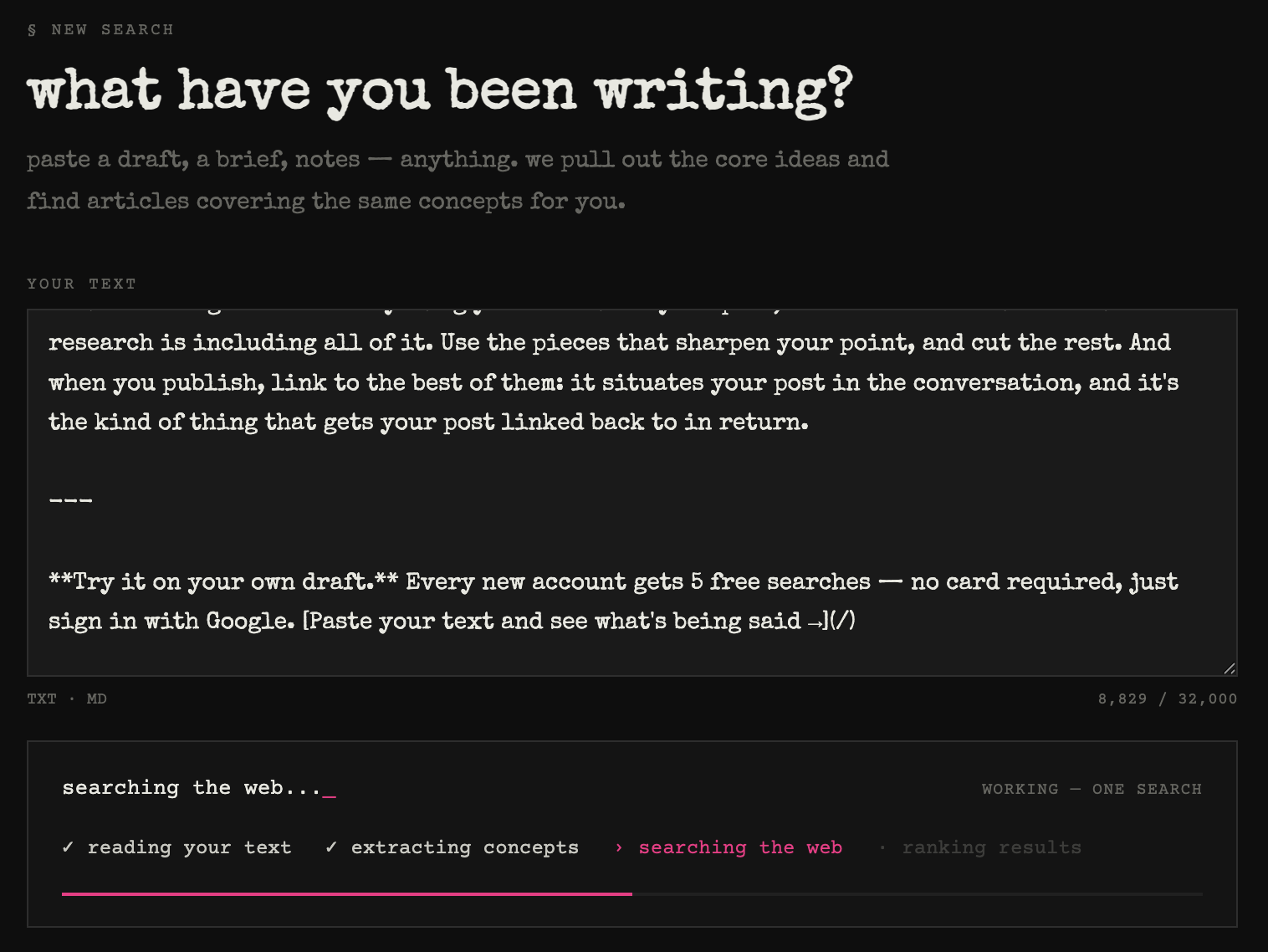
Instead of you brainstorming search terms, you paste your draft (or brief, or messy notes) and BeingSaid reads it, pulls out the 3–7 core ideas it's actually about, searches each one, and ranks the articles by how many of your ideas surfaced them. The pieces at the top are the ones sitting at the same intersection of ideas as your draft — the real competition for your ground. That's steps 3 and 4, done exhaustively, in under a minute.
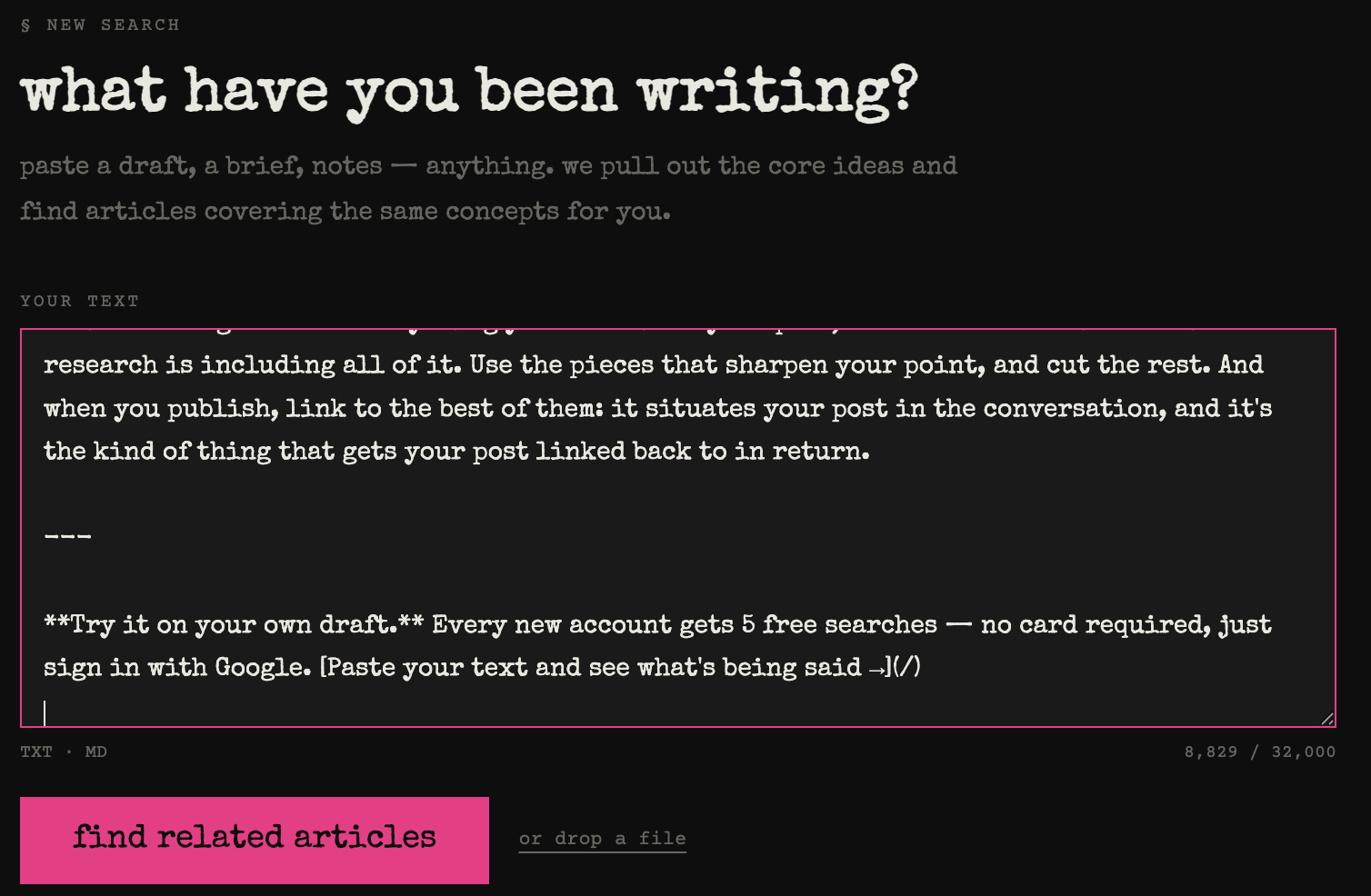
Try it on your own draft. Every new account gets 5 free searches — no card required, just sign in with Google. Paste your text and see what's being said →
Running the gap analysis with BeingSaid, step by step
Paste your text. A draft, an outline, or notes — up to about 32,000 characters, pasted directly or uploaded as a .txt or .md file. You don't reduce it to keywords first; the writing itself is the input, which means the ideas you're too close to notice still get searched.
BeingSaid extracts the ideas and searches each one. It identifies the distinct concepts in your piece — the separate lanes from step 1 — and runs a web search for each. This is idea-level matching, not literal keyword matching, so it catches related pieces that never use your exact phrasing.
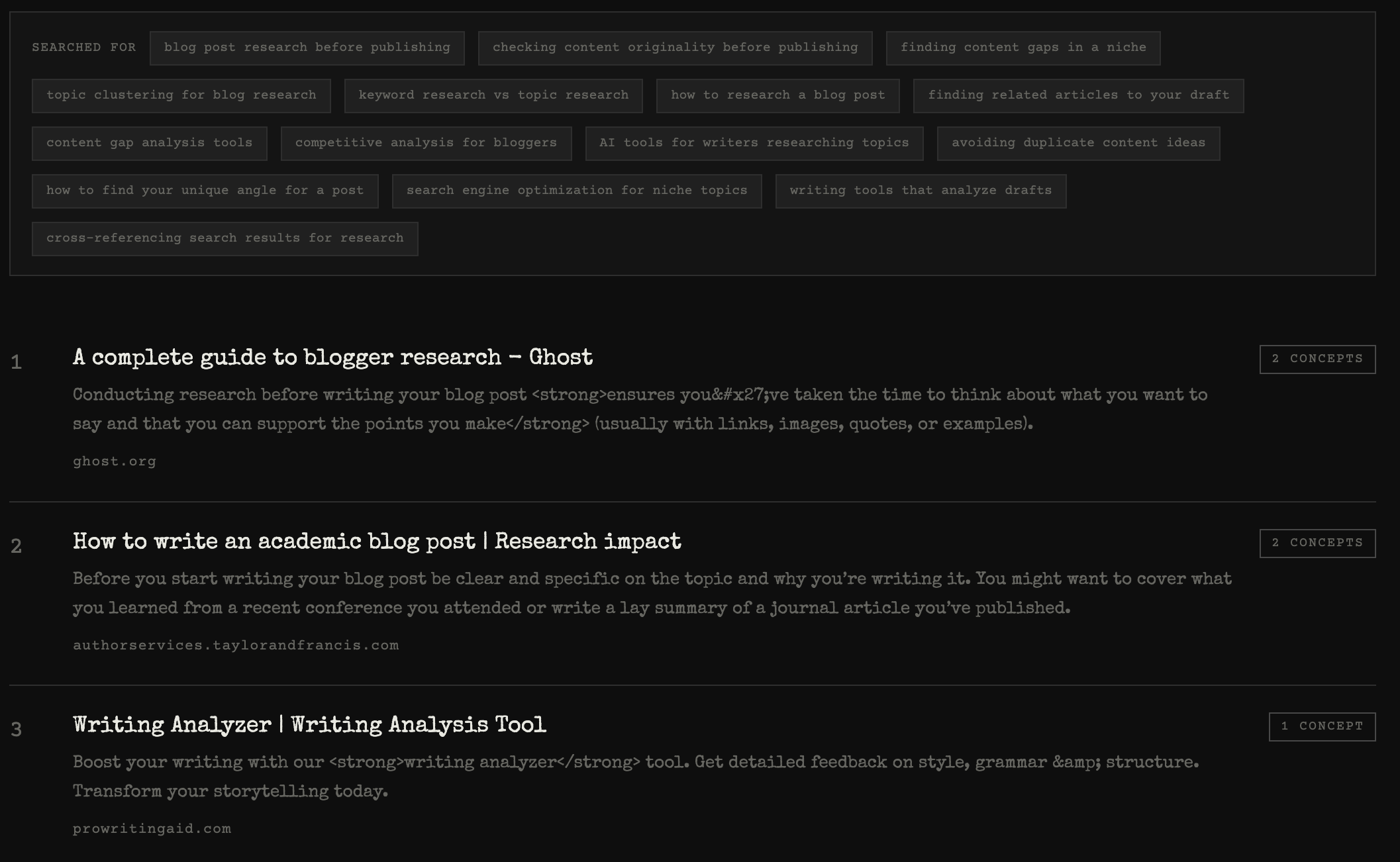
You get the competing pieces, ranked by overlap. The results are the articles most like your draft, each showing which and how many of your ideas surfaced it — the cross-reference from step 4, done for you. A "see more" expands past the top 5 when you want to go deeper, and the extracted ideas are listed so you can check what it searched.
Then you do the human part. Read the top matches, note what they all repeat, and — the whole point — pay attention to what none of them say. That's your gap and your angle. BeingSaid finds the conversation; naming the missing piece is still your judgment, which is exactly as it should be.
Reading the gap: what the results tell you
The ranked list is only half the value. Two patterns are worth watching for:
Everything clusters tightly. If the top results all say the same few things, you've found a saturated, consensus-heavy topic. Winning here means information gain — a data point, a first-hand result, or a defensible contrarian take none of them offer. Matching them isn't enough anymore.
Nothing matches more than one idea. If BeingSaid pulls seven ideas out of your draft and no article surfaces for more than one of them, your piece spans a combination nobody has written about together. Sometimes that's a genuine open lane — the intersection is yours. But it can also be a warning that the topic is so unusual search engines won't know how to index it and readers won't know how to find it. Better to learn that before you publish than three months into no traffic.
Common mistakes to avoid
- Confusing "a keyword you don't rank for" with "a gap worth filling." Some gaps exist because nobody searches for them. Check that there's real demand — from search, but also from support tickets, sales calls, and community questions, which surface topics that never get typed into a search box.
- Copying the consensus instead of extending it. If your analysis just tells you to write what's already ranking, you've mapped the competition but skipped the gap. Aim to complement the existing pages, not clone them.
- Trying to include everything you found. The most common research mistake is folding all of it into your draft. Use the pieces that sharpen your point; cut the rest.
- Treating it as one-and-done. Topics move. Rerun the analysis on your key pieces periodically so a post that led the field last year doesn't quietly fall behind.
Where this fits
A content gap analysis is the workflow; running it well is a habit. If you want the broader version of this — the full routine for checking what's already out there before you write anything — start with the pillar guide, How to Find Out What's Already Been Written About Your Topic. And when the gap you're chasing is really an originality check — has anyone already made my exact point? — that's its own focused workflow, covered in Has This Been Said Before?.
Find your gap in one paste. BeingSaid reads your draft, searches every idea in it, and ranks what's already out there — so you can see what everyone's saying and spot what they're missing. Every new account gets 5 free searches, no card required. Paste your text and see what's being said →