How to Find Counterarguments to Your Own Writing
You've finished the draft and you believe it. That's the problem.
The whole time you were writing, you were building a case for your point — reaching for the evidence that fits, phrasing things the way that lands, quietly stepping around the objections you half-noticed. That's not dishonesty, it's just how drafting works. But it means the version of your argument you can see is the flattering one. The holes are real, and someone will find them; the only question is whether it's you now or a reader in the comments later.
Finding the counterarguments to your own writing is the move that turns an opinion into something durable. If your position survives the strongest objection you can throw at it, it's genuinely robust. If it cracks, you've just found the exact place to shore up — or the honest reason to change your mind — before you publish instead of after. This guide is about how to surface those objections deliberately: the manual way writers have always done it, and how BeingSaid shortcuts the slowest part.
Why your own draft hides its weak spots
Two forces work against you. The first is that you know what you meant, so your eyes slide over the gap between what you meant and what you actually argued. The second is more stubborn: you went looking for reasons you're right and found them, which is exactly what everyone does with a position they hold. Left alone, self-editing catches typos and clunky sentences — it rarely catches a missing argument, because the missing argument is invisible from the inside.
The fix that professionals borrow from debate and from proposal work is to stop defending and start attacking. Reviewers who "red-team" a document ask a deliberately hostile question: if I were paid to discredit this, where would I pick the holes? That reframing is the whole trick. You're no longer the author protecting a draft; you're an opponent hunting for the weakest joint. The notes that come out of that pass are the counterarguments worth answering.
Steelman, don't straw man
There's a right and a wrong way to represent the other side, and the wrong way is worse than skipping it.
A straw man is a weak, distorted version of the opposing view that you set up precisely because it's easy to knock down. Readers see through it instantly, and it makes your own argument look scared. A steelman is the opposite: you reconstruct the opposing position as strongly, fairly, and persuasively as possible — clearing away its obvious errors, adding the best evidence its defenders would use, even the reasons they haven't articulated but would accept — and then you respond to that.
Steelmanning does two things at once. It pressure-tests your position against the real objection instead of a decoy, and it earns the reader's trust: showing you understand the other side accurately is a standard mark of a serious argument, not a concession. The goal isn't to find counterarguments you can dismiss. It's to find the ones that are actually good.
The by-hand version
Done deliberately, hunting counterarguments is about five steps.
1. State your claim in one flat sentence
Strip the hedging and write the single sentence a critic would quote to disagree with you. Not "there are pros and cons to remote work" — that's un-disagreeable — but "remote work makes teams more productive." A claim someone can push against is the only kind that has counterarguments. If you can't write the flat sentence, your draft may not have a point yet, which is its own useful thing to learn.
2. List who would object — and why they're not fools
Write down the people who'd push back, and make each one smart. The manager who's watched output drop. The new hire who learned nothing over Slack. The researcher with data cutting the other way. Choose the objections a real, reasonable reader would actually raise rather than the fringe ones — one or two serious counterarguments answered well beats ten swatted flies.
3. Steelman each objection
Take your two or three strongest objections and build each into the best version of itself, per the section above. Look for the evidence, the analogy, the real-world case that would make a fair reader nod along. If a steelmanned objection makes you a little uncomfortable, you've found a good one.
4. Go find the people already making those arguments
This is the slow part, and the part most writers cut. Search for each objection and read the people who hold it in their own words — you'll almost always find the counterargument is sharper, or better-sourced, than the version you imagined. A claim touches several ideas, so it's several searches, not one, and the objections that matter most are the ones that keep surfacing across them. It's a couple of hours of tabs and skimming, and — as with any research pass — the highest-value step is the one human attention is worst at: noticing which sources keep coming back.
5. Decide: concede, refute, or revise
For each counterargument you now have three honest options. Refute it — show the flaw, or why your case holds anyway. Concede the part it gets right, then explain why it doesn't sink your thesis; a well-handled concession makes you more convincing, not less. Or revise — if the objection is simply right, change the argument. That last one isn't a failure. Catching it before you publish is the entire point.
The one-step version
Steps 2 through 4 — imagining who disagrees, then hunting down the strongest versions of what they actually say — are exactly what BeingSaid was built to shorten. It reads your draft, pulls out the ideas inside it, and finds the pieces across the web most engaged with those ideas — which, crucially, includes the ones arguing the other way.
Paste your draft. The whole piece, an outline, or a messy notes file — up to about 32,000 characters, pasted directly or uploaded as a .txt or .md file. You don't reduce it to search terms first; the writing itself is the input.
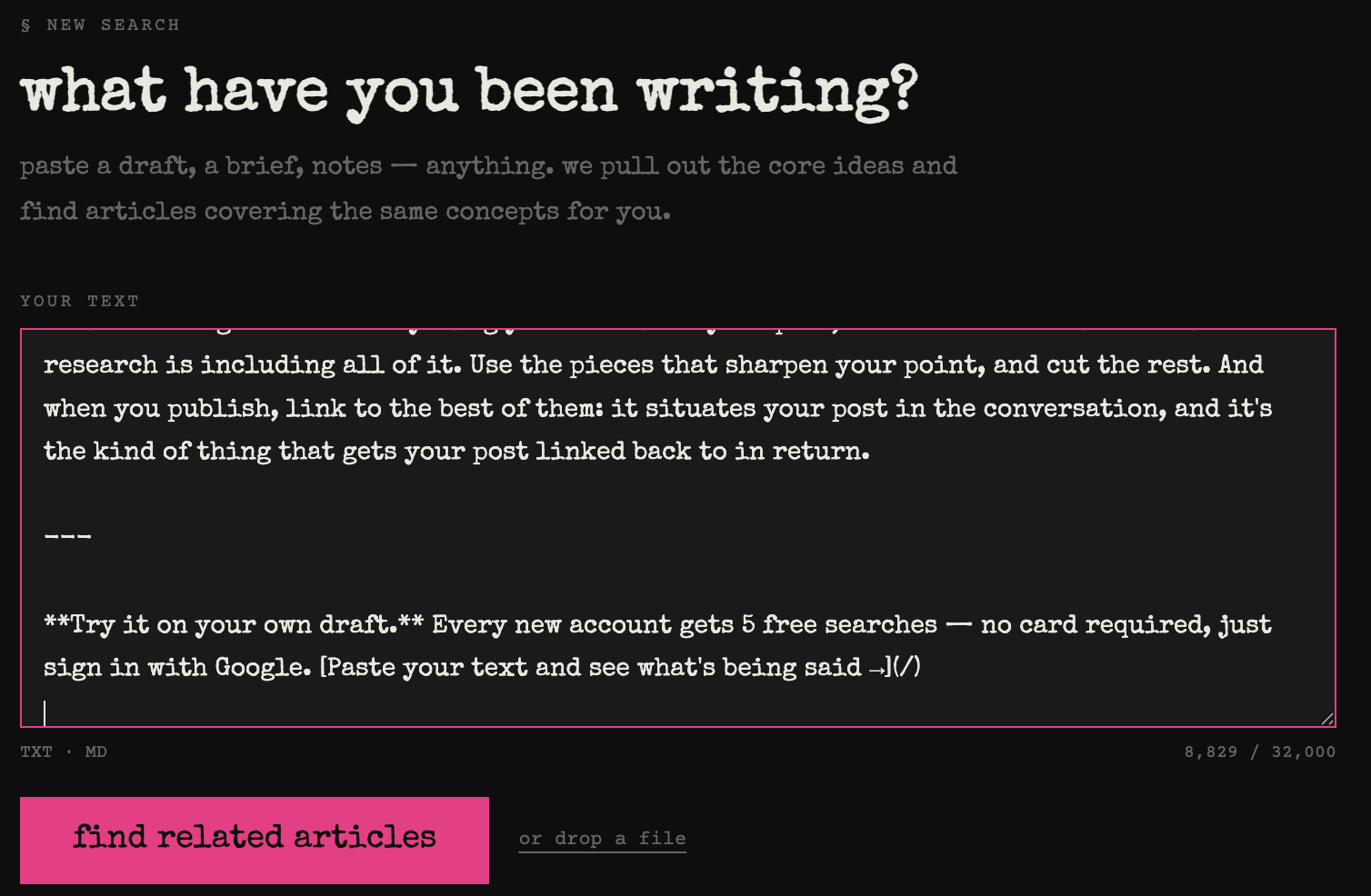
BeingSaid pulls out the ideas your piece rests on. Instead of you brainstorming who might object, it identifies the 3–7 core ideas your argument depends on — including the load-bearing assumptions you're too close to your own draft to see as debatable. Those assumptions are precisely where the counterarguments live.
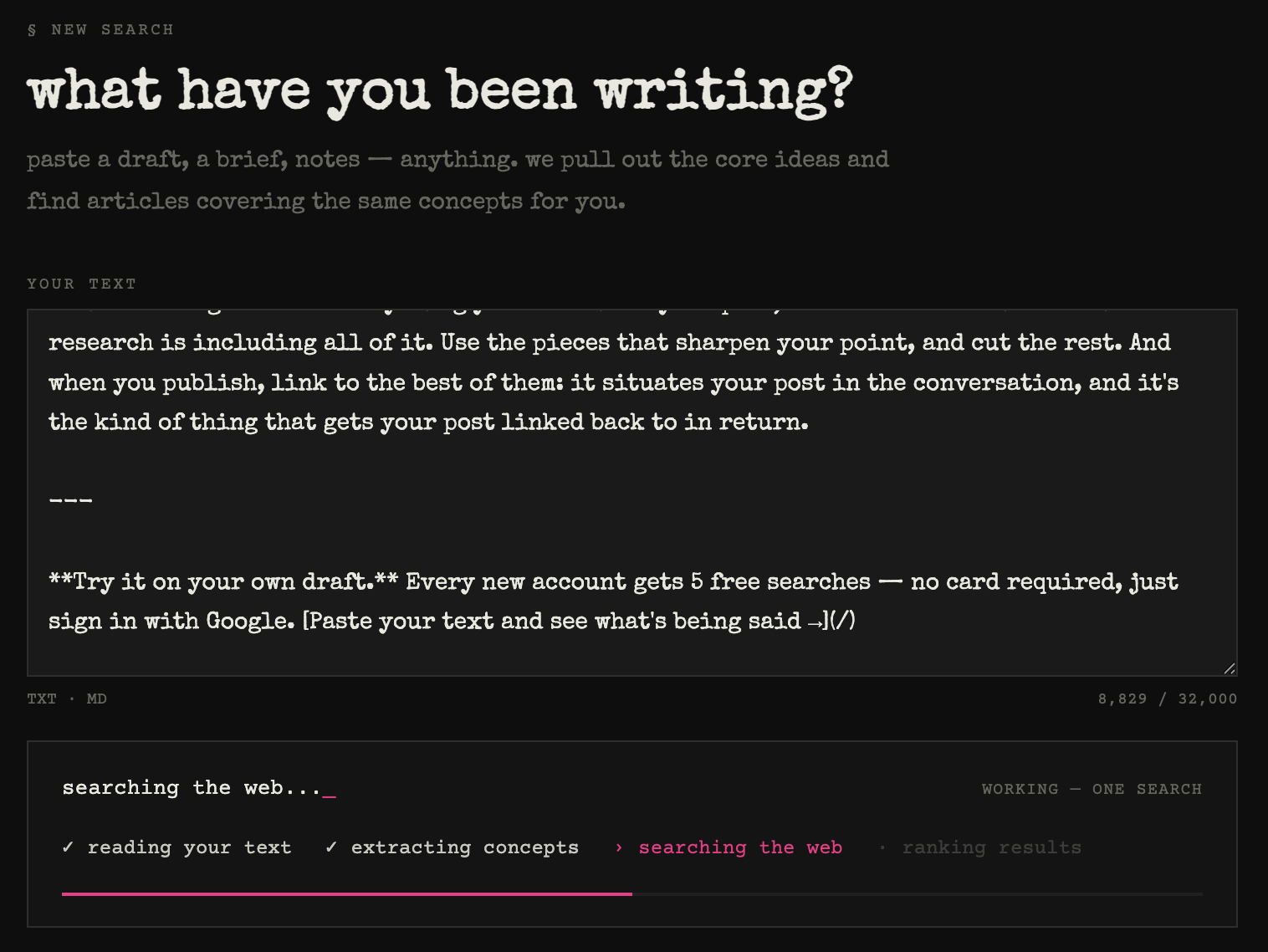
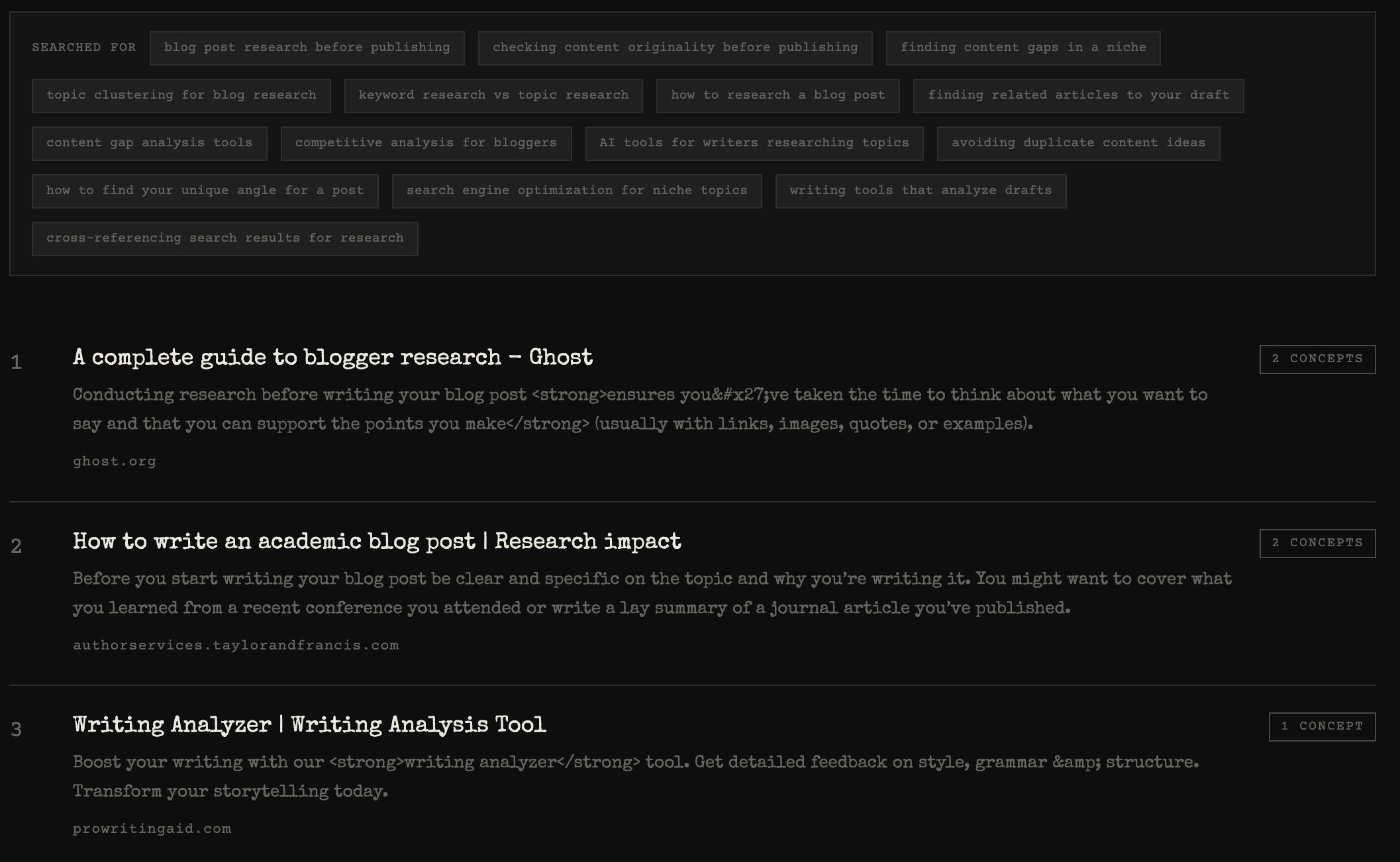
Every idea gets searched, and the surrounding conversation gets ranked. The whole run takes under a minute and returns the articles most engaged with your ideas, ranked by how many of them each piece surfaced. The pieces that keep coming back are the ones sitting on your ground — the agreements to cite and the disagreements to answer.
You read the results with an opponent's eye. BeingSaid hands you the shortlist of who's already in this conversation; it doesn't reproduce their pages, it points you to them. Open the ones that take the opposite line, read them in full, and steelman from the source instead of from memory. The extracted ideas are listed too, so you can see which of your assumptions pulled up the most pushback.
What to do once you've found them
The tool gets you to the objections faster; the thinking is still yours. Read the opposing pieces charitably — with neutral, matter-of-fact language rather than a sneer, because a hostile summary of the other side reads as insecurity. Pick the one or two objections a serious reader would actually raise, work them into your draft as steelmanned counterarguments, and then refute, concede, or revise. Skip the fringe ones; answering every possible objection buries your thesis under caveats.
And notice the quiet win: if you go looking for the strongest case against your position and it holds, you can write with a confidence you couldn't have faked. You've already met the objection. Now your reader can't spring it on you.
Try it on your own draft. Every new account gets 5 free searches — no card required, just sign in with Google. Paste your text and see what's being said →
More on the research pass this builds on: How to Find Out What's Already Been Written About Your Topic.