How to Run a Competitive Content Audit (Without a Spreadsheet Nightmare)
You've been handed a topic to cover, and before you plan a single piece you need to know what you're walking into. Who already owns this ground? What angles are saturated, and which ones has everybody missed? That's a competitive content audit, and done well it's the difference between publishing something that adds to the conversation and publishing something that quietly repeats it.
The problem is the standard way to do one starts with a blank spreadsheet. Columns for URL, title, format, word count, keywords, backlinks, notes. Then hours of pasting, tab-switching, and skimming to fill it in — an auditor can typically handle only five to seven pages an hour, which is how a "quick competitive scan" turns into a week of your life. And the single most useful output — knowing which pieces keep coming up across every angle of your topic, because those are the ones truly competing with you — is the part a spreadsheet is worst at showing you.
This guide covers both: the full manual audit that content strategists actually run, and how BeingSaid collapses the most tedious slice of it — the per-topic competitive scan — into one paste-and-run.
What a competitive content audit is actually for
A competitive content audit is a structured look at what your competitors have published on a topic, so you can find the openings they've left. The payoff is a content gap analysis — the topics, angles, and questions the field is either missing or covering badly. Topic gaps are usually the highest-value ones: a whole subject nobody has treated with real depth is a cluster of pieces you can own, not a single-page fix.
But you can't spot the gap until you've mapped what's already there. That mapping is the audit, and most of it is manual labor.
The by-hand version
Content strategists have a well-worn playbook for this. Run properly, it's roughly six steps.
1. Define the ground you're auditing
Get specific about the topic before you touch a search box. "Email marketing" is a category; "how B2B teams re-engage cold email subscribers" is a piece of ground you can actually audit. The tighter your definition, the more honest the audit — a broad topic returns thousands of loosely related results and tells you nothing about who you're really competing with.
2. Identify your real competitors
These aren't only your business competitors — they're your search competitors. Search the terms you want to own and note which sites keep showing up in the results. Include the direct competitors you'd expect and the indirect ones — the independent blog, the adjacent SaaS, the publication that keeps outranking everyone. Whoever occupies the results is who you're up against, brand recognition aside.
3. Inventory their content
For each competitor, catalog what they've published on your topic. This is the spreadsheet grind: URL, title, format (blog post, guide, video, case study), publish date, and a rough sense of depth. Do a fast pass to see the shape of their coverage, then go deeper on their strongest pieces rather than trying to log everything — on a large site, logging everything is where audits go to die.
4. Assess quality, depth, and angle
Now read the pieces that matter. Note headline structure, how deep each one goes, what examples they use, and — most importantly — the angle. Two articles on the same topic can take opposite positions; that's the texture you're mining. Watch especially for topics competitors cover without real depth or a clear point of view — the reader finishes and still doesn't know what to do. Those are open lanes.
5. Find where the same pieces keep resurfacing
This is the highest-value step and the one a spreadsheet hides. Your topic has several facets, and you searched each of them. The articles that surface across several of those searches — not the ones ranking #1 for a single term — are the ones genuinely covering your ground. Repetition across facets is the relevance signal. But to see it by hand you'd have to cross-reference every result list against every other, which is exactly the kind of tallying human attention is worst at after forty open tabs.
6. Turn it into a plan
Group your findings — saturated angles to avoid, thin spots to exploit, formats the field is under-using — and turn them into a content plan. A well-structured summary is what separates an audit that changes your strategy from one that just lives in a spreadsheet. And plan to repeat it — a competitive audit is a quarterly habit, not a one-time project, because coverage and rankings shift underneath you.
Done honestly, this works. It also eats hours before you've planned a single piece — and step 5, the most valuable one, is the part the spreadsheet actively works against.
The one-step version
BeingSaid won't crawl a competitor's entire site or pull their backlink profile — that's the enterprise-tool part of the audit. What it collapses is steps 2 through 5 for a single topic or draft: the per-topic competitive scan where you figure out who's already covering your ground and which pieces are really in the ring with you.
Paste in the draft, the brief, or even a paragraph describing the topic, and it maps the surrounding conversation for you — by reading what the text is actually about, not by matching keywords you had to guess at first.
Paste your text. A rough draft, a content brief, an outline, a few sentences of topic notes — anything up to about 32,000 characters, pasted directly or uploaded as a .txt or .md file. You don't pre-distill it into search terms; the writing itself is the input.
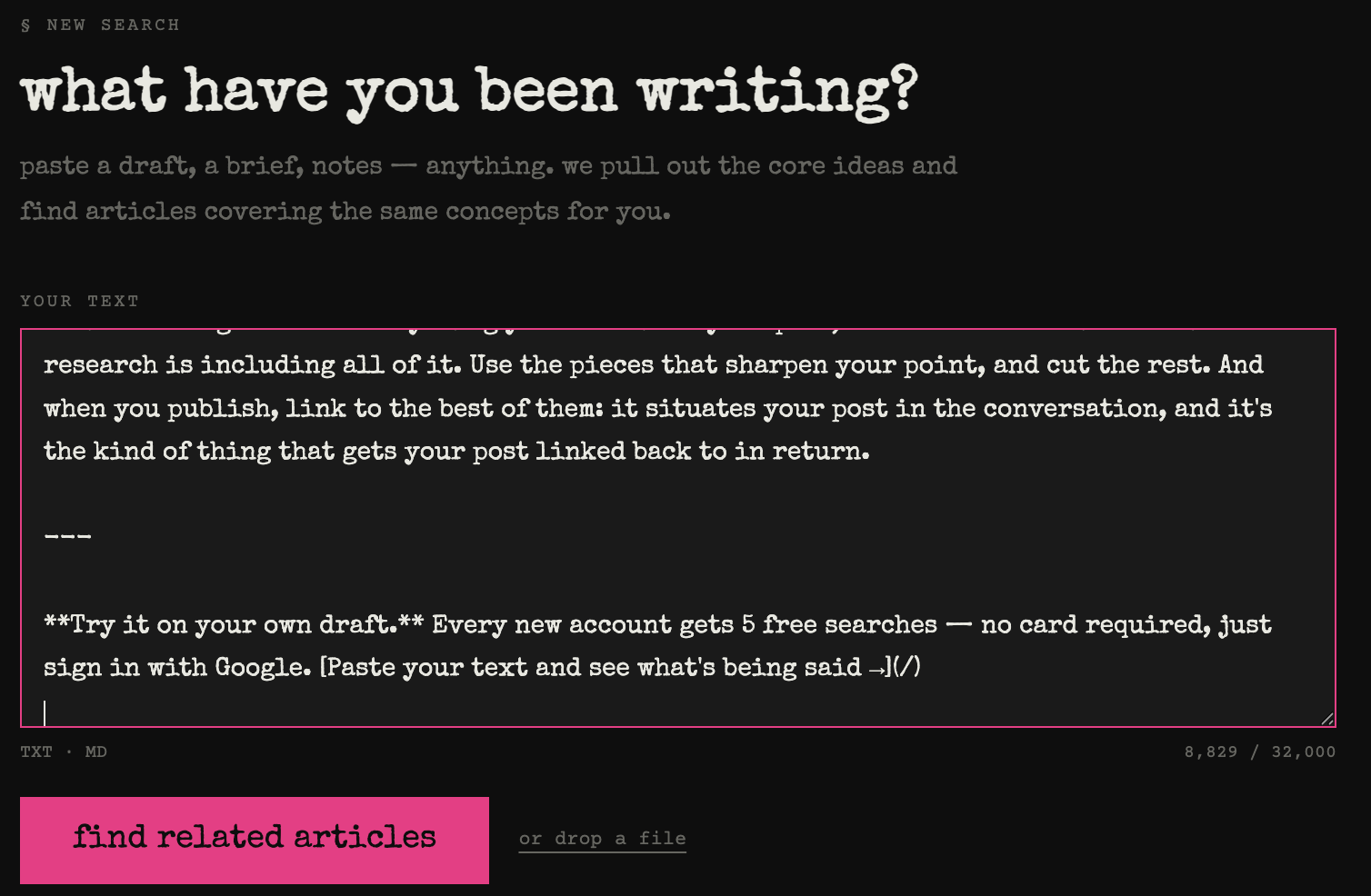
BeingSaid pulls out the facets of your topic. Instead of you brainstorming the three-to-seven angles to audit, it reads the text and identifies the core ideas inside it — including the facets you're too close to your own brief to see as separate searches. This is steps 1 and 2 done automatically: your topic, broken into the distinct fronts you're actually competing on.
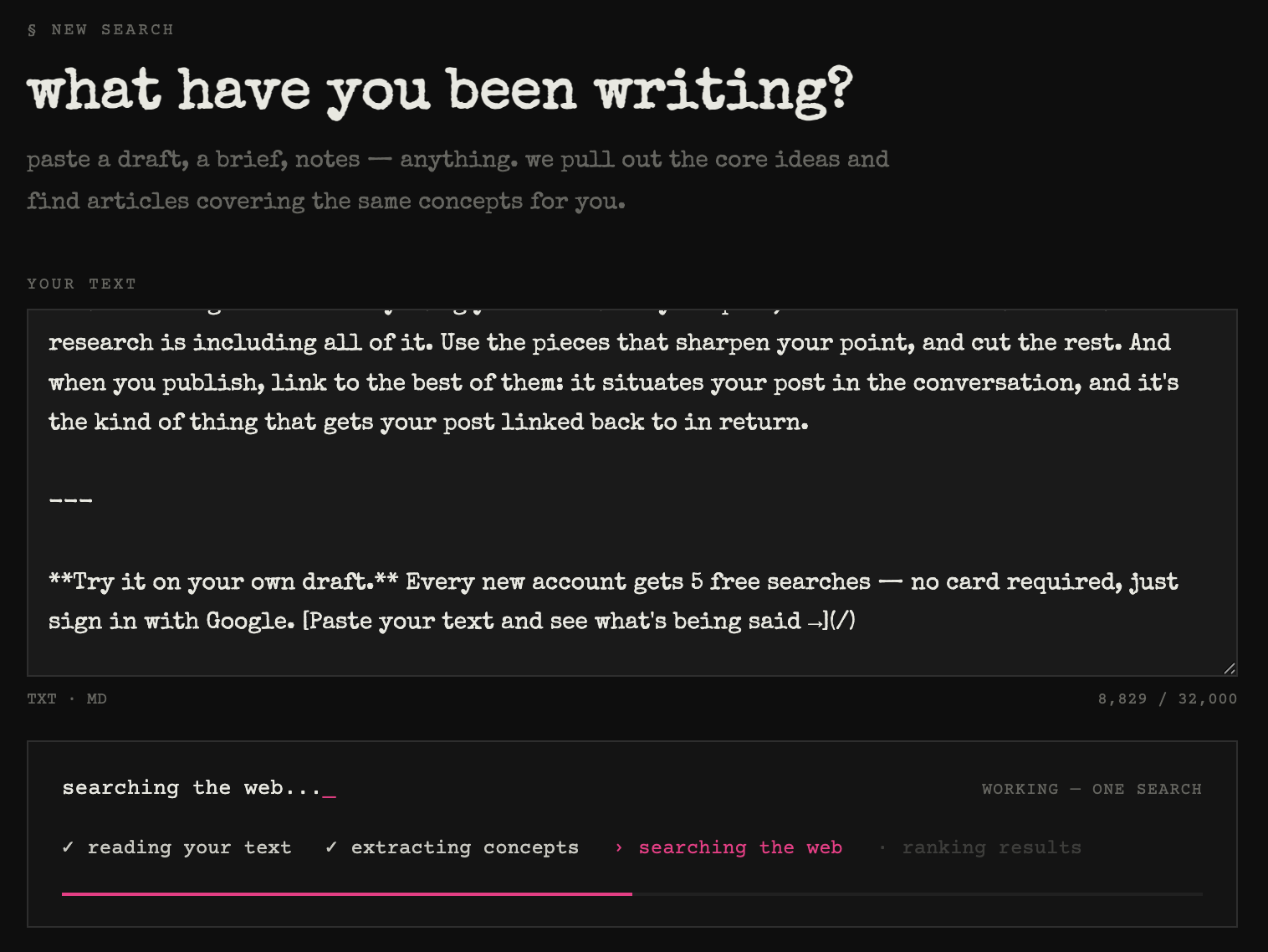
Every facet gets searched, and the results get cross-referenced. This is step 5 — the tallying no one wants to do by hand — done exhaustively. Every result from every facet is compared, and articles are ranked by how many of your topic's angles surfaced them. The whole run takes under a minute, no spreadsheet required.
You get the pieces genuinely competing with you, ranked. The top results are the articles sitting at the same intersection of ideas as your brief — each showing which and how many of your facets surfaced it, with a "see more" behind the top five when you want the full field. The extracted facets are listed too, so you can sanity-check what it searched and treat that list as the skeleton of your audit.
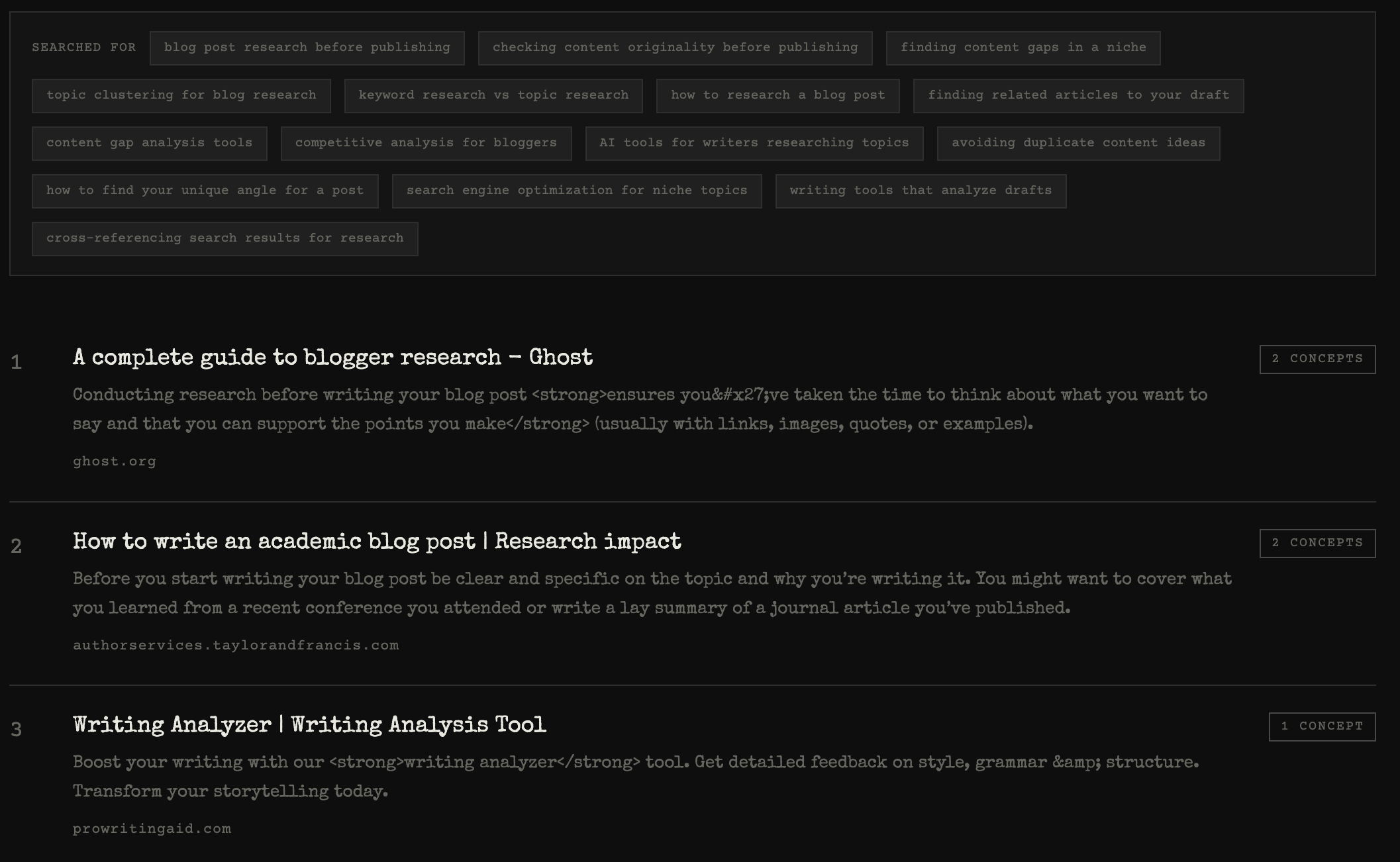
Reading the result as an audit
The ranked list is your competitive map. A few things to read from it:
The pieces matching the most facets are your real competition — the ones covering the same ground from the same intersection. Read those closely for angle, depth, and point of view, the way step 4 asks you to.
If a facet BeingSaid pulled from your brief surfaces almost nothing, that's a gap worth noticing. Sometimes it means an open lane — a real angle nobody's claimed. Sometimes it's a warning that the angle spans topics readers don't search for together, which is worth catching before you commit a quarter's calendar to it.
And where the top pieces all repeat the same points but skip the thing you know matters — that skipped thing is your content gap, and your reason to publish. If you want to go deeper on turning that gap into a plan, the content gap analysis guide picks up exactly there, and the pillar guide on finding what's already been written covers the underlying research habit.
Where this fits in the bigger audit
To be clear about scope: a full competitive content audit still includes work BeingSaid doesn't do — backlink profiles, publishing cadence, site-wide inventories, the enterprise SEO-tool layer. BeingSaid isn't trying to replace that. What it replaces is the slowest, most manual, most attention-hungry slice: figuring out, for a given topic, who's already there and which pieces are truly in the ring with you. Run that part in a minute instead of an afternoon, and you can afford to do it for every piece you plan — not just once a quarter when someone finally has time to open the spreadsheet.
Run it on your next brief. Every new account gets 5 free searches — no card required, just sign in with Google. Paste your text and see what's being said →