How Content Strategists Scan a Topic in 5 Minutes
A writer researching one blog post can afford to spend an afternoon on it. A content strategist can't. You have a backlog of topics to brief, a calendar to fill, and a stakeholder who wants to know by end of day whether "should we write about X" is a yes. Nobody's paying you to read forty tabs per idea. The skill that separates a strategist from a writer isn't going deep on one topic — it's sizing up a topic fast enough to make a call, then moving to the next one.
That call has three parts. Is this space saturated or open? What is everyone already saying? And where is the angle nobody's taken? Get those three answers and you can write a brief. The trap is that answering them properly looks like hours of work — which is why most quick topic scans skip straight to "what's ranking on page one" and miss the two answers that actually matter. This guide is the five-minute version that doesn't skip them, and how BeingSaid collapses the slowest step into a single run.
Why "competitive content research" is different for a strategist
When a writer does competitive research, they're serving one piece: what's out there on my exact topic, and how do I beat it? A strategist is doing something broader and shallower — mapping the conversation around a topic to decide whether it's worth a piece at all, and if so, what shape that piece should take. You're not trying to read everything. You're trying to read the pattern.
The pattern is what competitive content analysis is really for: not copying what ranks, but spotting where everyone clusters and where the coverage thins out. Semrush frames the payoff the same way — the point of a competitive content analysis is to find the content gap, the thing your audience wants that nobody has written well yet. A strategist who can find that gap in five minutes instead of five hours can brief ten times as many topics.
The five-minute scan
Time-box it before you start. Deciding up front that a topic gets five minutes — not "until I feel done" — is the single change that makes this repeatable. Research expands to fill whatever time you give it, and the difference between a focused scan and open-ended exploration is rarely better content, just a later brief. Five minutes, five moves.
1. State the topic as a sentence, not a subject (30 seconds)
"Remote onboarding" is a subject. "Why remote onboarding fails in the first two weeks" is a topic you can scan. A subject returns everything; a sentence points at the specific conversation you're deciding whether to enter. If a stakeholder handed you a one-word brief, your first job is to turn it into a sentence — that act alone surfaces the sub-ideas you'll actually search.
2. Break the sentence into its real sub-topics (1 minute)
A topic worth a piece is never one search. "Why remote onboarding fails in the first two weeks" touches onboarding logistics, early attrition, remote team culture, and manager training — four distinct conversations, each with its own set of players. List them. This is the step that separates a strategist's scan from a writer's Google search: you're not searching the headline, you're searching the ideas underneath it, because the strongest signal is which articles surface across several of them at once.
3. Scan each sub-topic for saturation, not answers (1.5 minutes)
Run each sub-topic and skim — titles and descriptions only, no reading. You're taking a temperature, not gathering sources. Is this cluster crowded with near-identical takes (a sign to find a sharper angle or skip it) or surprisingly thin (an open lane)? In 2026 this pass has to include the AI layer: SERP analysis now means checking who gets cited in AI Overviews and ChatGPT-style answers, because a competitor answering the query inside an AI Overview is capturing attention you'll never see in a rank tracker.
4. Find the crossover (the slow step)
Note which articles and which domains keep reappearing across your sub-topics. A piece that surfaces for three of your four sub-ideas is covering your ground far more than one that ranks first for a single term. This crossover is the map: the recurring names are the conversation you'd be entering, and their shared blind spot is your opening. It's also the step that blows the five-minute budget, because tracking overlap across four searches by hand is exactly what human attention is worst at. Everyone tells you to find the gap; nobody tells you the gap only shows up once you've tracked the overlap.
5. Name the angle and write one line (30 seconds)
Close the scan with a single sentence for the brief: "Everyone covers the tools; nobody covers the manager's first week — that's ours." That line is the deliverable. If you can't write it, the topic isn't ready to brief yet, and the scan just saved you from commissioning a rehash. Finding that fresh angle — the thing competitors overlooked rather than a slightly better version of what they said — is the whole reason to scan before you brief.
Where the five minutes actually go
Steps 1, 2, 3, and 5 are fast — they're judgment calls, and judgment is what you're good at. Step 4 is the one that quietly turns five minutes into thirty, because it's clerical: open tabs, note domains, cross-reference, try to hold four result lists in your head at once. It's also the highest-value step, since the crossover is where the gap hides. That's the exact inversion that makes topic scanning feel slower than it should — the most valuable move is the one your brain is worst at doing quickly.
The one-run version
BeingSaid does step 4 for you, which is what keeps the scan inside its time box. You skip the tab-management and keep the judgment.
Paste the topic — or a rough brief, or a competitor's article, or your own notes. Anything up to about 32,000 characters, pasted or dropped in as a .txt or .md file. You don't pre-write search terms; the text itself is the input.
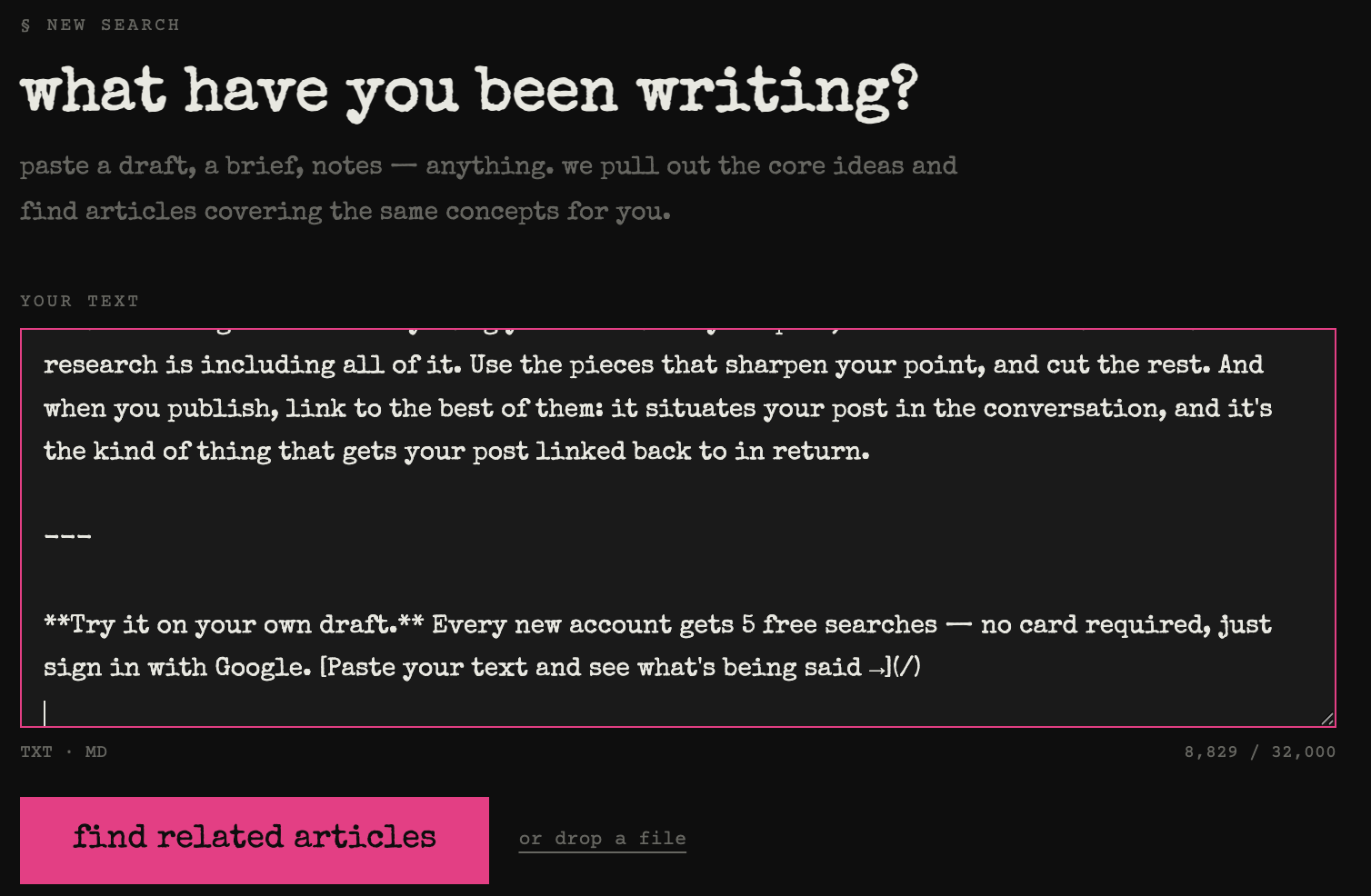
It reads the text and pulls out the sub-topics. Instead of you listing the ideas underneath the headline, BeingSaid identifies the 3–7 concepts the text actually spans — including the ones you're too close to the brief to see as separate conversations. This is steps 1 and 2, done for you.
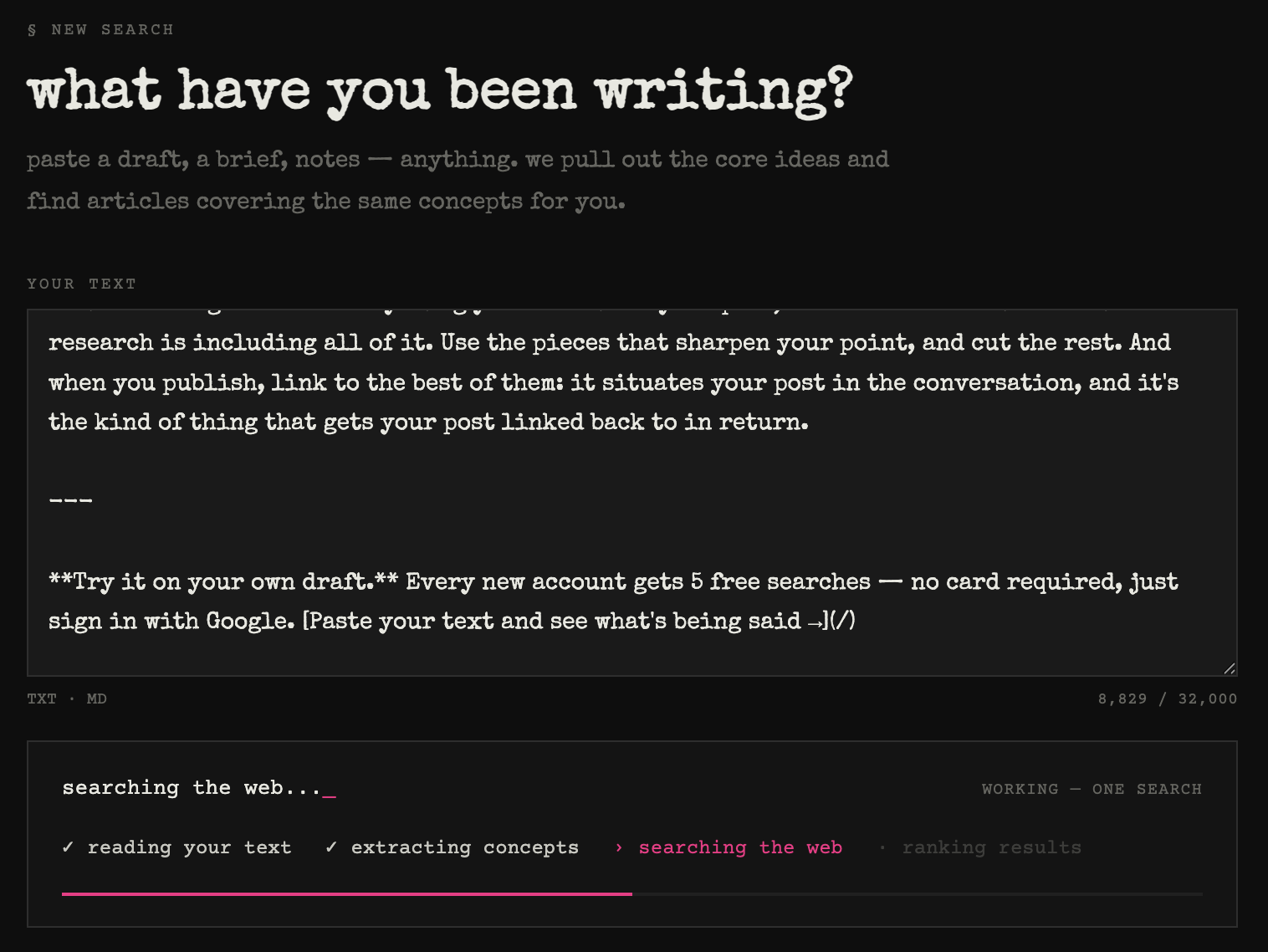
Every sub-topic gets searched and cross-referenced. This is step 4 — the slow, clerical one — done exhaustively: every result from every concept search is compared, and articles are ranked by how many of your sub-topics surfaced them. The whole run finishes in under a minute.
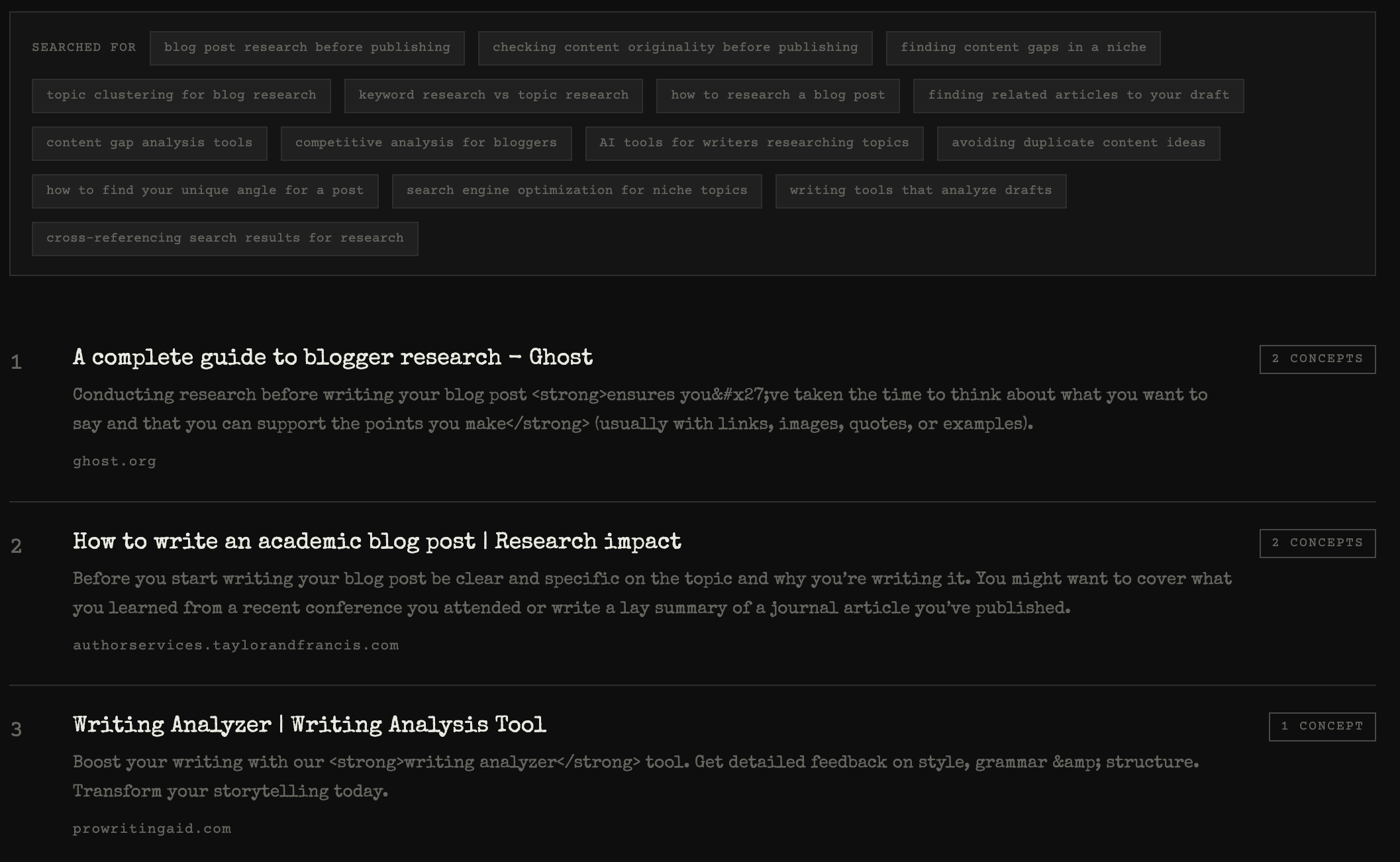
You get the crossover map, ranked. The top results are the pieces sitting at the same intersection of ideas as your topic — each showing which and how many of your sub-topics surfaced it, so the recurring players in the conversation are ranked to the top instead of buried across forty tabs. The extracted concepts are listed too, so you can sanity-check the scan and read the saturation off the match counts: lots of high-crossover results means a crowded space; a thin, scattered list means an open lane.
Turning the scan into a brief
The run hands you the map; the call is still yours — that's the part worth your time. Read the top few crossover pieces, note the point they all repeat (that's the saturated center, your competition), and pay attention to what none of them say (that's the gap, your angle). Then write the one-line angle from step 5 and the brief is halfway done.
Two habits keep this honest. First, don't fold everything the scan surfaced into the brief — the most common research mistake is including all of it instead of the two or three pieces that sharpen the angle. Second, treat a scan that comes back with no crossover as information, not failure: if nothing ties your sub-topics together, either you've found genuinely open ground or the topic spans ideas nobody searches together — and it's cheaper to learn that now than after the piece publishes to no traffic.
Run it across your whole backlog in an afternoon and you're not sizing up topics one at a time anymore — you're triaging a quarter's worth of ideas by how much open ground each one has.
Related reading
- How to Find Out What's Already Been Written About Your Topic — the full method behind the crossover signal, for a single piece.
Scan your next topic in one run. Every new account gets 5 free searches — no card required, just sign in with Google. Paste a topic and see the conversation around it →