Has This Been Said Before? A Simple Way to Check Before You Publish
You finish a draft you're proud of, move the cursor over publish, and a small voice stops you: hasn't someone already said this? Maybe a bigger blog covered your exact angle last month. Maybe the take that felt fresh at 11pm is the same one making the rounds. The worry that your idea has been written about before is one of the most common reasons good posts sit unpublished — and it's worth taking seriously, because a five-minute check beats finding out in the comments.
But "has this been said before?" is the wrong question to answer with a gut feeling. It's the right question to answer with a quick look at what's actually out there. This guide reframes the anxiety into something concrete you can check, shows you the by-hand version, and shows how BeingSaid collapses the check into one paste-and-run.
First, the honest answer: yes, probably — and that's fine
Here's the thing every experienced writer eventually makes peace with: on any topic worth writing about, something has been said before. Writers who won't publish until they're certain their idea has "never been done" mostly never publish. As one reflection on the fear of originality puts it, everything has been said before — but it needs to be said again, because there's always someone who needs to understand it more deeply, and there's always a new voice to say it in.
So the goal of the check isn't to prove nobody has touched your topic. That bar is impossible, and chasing it is how you talk yourself out of writing. The goal is narrower and far more useful: find the handful of pieces closest to your specific take, so you can see whether your exact angle is already out there and, if it is, find the twist that still makes yours worth reading. Originality, in practice, isn't an untouched topic — it's the value you add on top of what already exists: your evidence, your position, your voice.
What you actually want to know
Turn the vague dread into three answerable questions:
The first is whether your exact take already exists. Not "has anyone written about remote work" — that's thousands of posts — but "has anyone made the specific argument my draft makes, for the same reason?" That's usually a much shorter list, sometimes empty.
The second is where the gap is. Once you can see the pieces closest to yours, you can see what they all skip. Content strategists call this the content gap — the thing readers want that nobody has quite written. What everyone already says is your competition; what nobody says is your post.
The third is who to link to. The best existing pieces aren't threats — they're the ones you cite, position yourself against, and situate your post among. Linking to them makes your post stronger and, often, gets you linked back.
Notice that none of these is answered by staring at your draft harder. All three need a look at what's already published.
The by-hand check
You can do this manually, and it's worth understanding the steps even if you later automate them, because they're what the tool is doing under the hood.
Start by saying, in one sentence, what your piece actually argues — not its subject. "Remote work" is a subject; "remote work quietly killed the mentorship junior employees used to get by osmosis" is a post. That sentence is where your real search terms hide.
Then pull the distinct ideas out of that sentence and search each one separately. Your remote-work piece isn't one search — it touches remote work, mentorship, early-career growth, and learning by osmosis. Four ideas, four searches, four piles of results. Skim each one; don't read deeply yet. You're scouting whether the ground is crowded or open.
Now the step that actually answers "has this been said before" — and the step human attention is worst at. Keep a running list of which articles show up across more than one of your searches. A post that surfaces when you search mentorship and learning by osmosis and early-career growth is sitting at the same intersection your draft does — it's far more likely to be covering your exact ground than a post that merely ranks #1 for a single broad term. Overlap across your ideas is the real "someone already said this" signal, not ranking within any one search.
Finally, read the few pieces that kept resurfacing. That short list is your honest answer. If your take is genuinely already out there, this is where you find out. And if it isn't — if the closest pieces each grab one thread but none pull them together the way you do — you've just confirmed your post is worth publishing, with the receipts to prove it.
Done carefully, this works. It's also an hour of tab-juggling before you've touched your draft, and the highest-value step — tracking overlap across searches — is exactly the part your memory drops around tab thirty.
The one-step version
BeingSaid runs that whole check for you. You don't pick search terms or track overlap by hand — you paste the draft you were about to publish, and it does the rest.
Paste your text. The finished draft, an outline, even a messy notes file — up to about 32,000 characters, pasted directly or uploaded as a .txt or .md file. You don't boil it down into keywords first; the writing itself is the input.
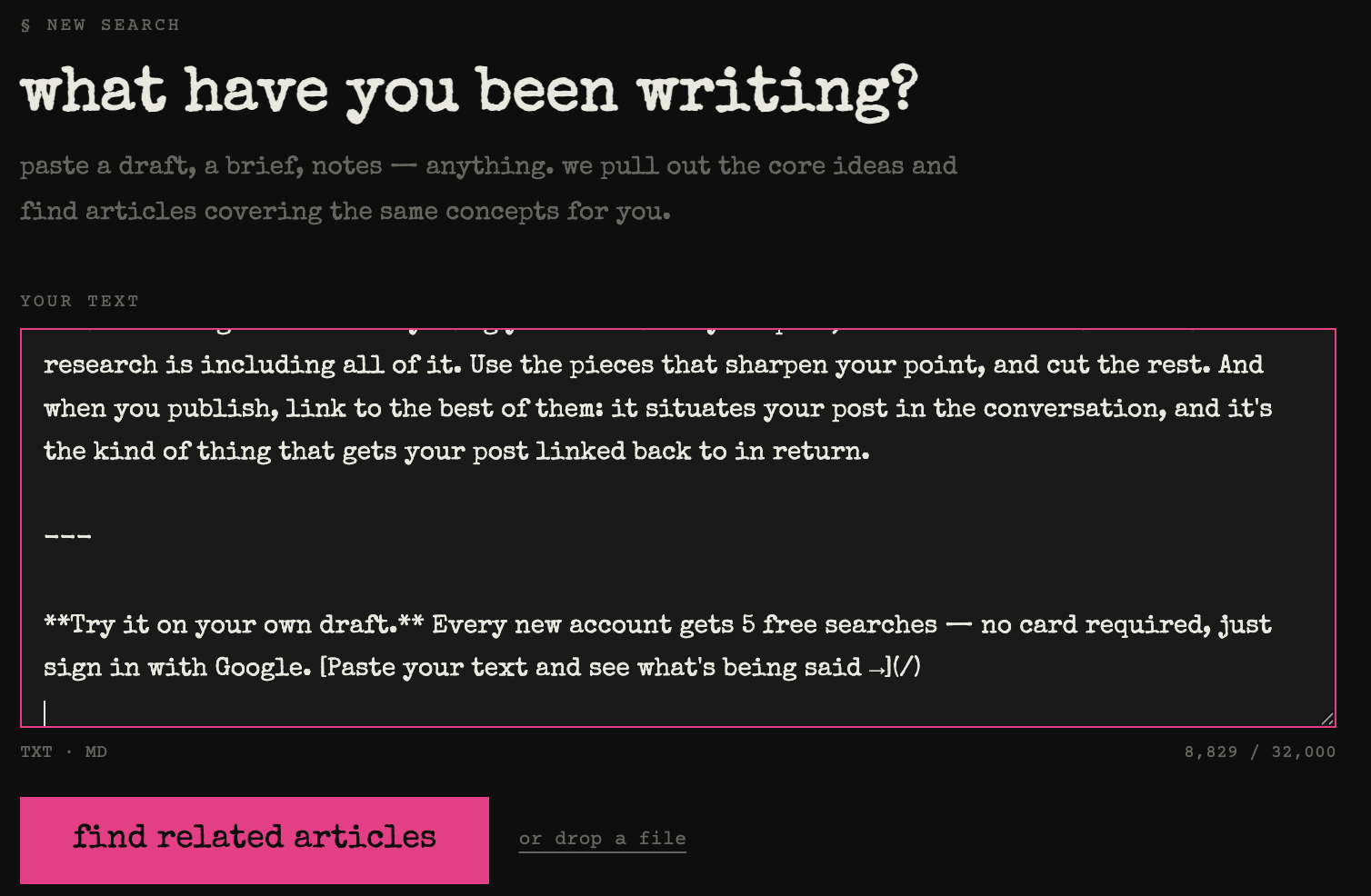
BeingSaid reads it and pulls out the ideas. Instead of you guessing search terms, it identifies the 3–7 core ideas your piece actually covers — including ones you're too close to your own draft to see as separate topics. It matches on ideas, not the literal words you happened to use, which is exactly the level "has this been said before" lives at: two posts can make the same argument in completely different words.
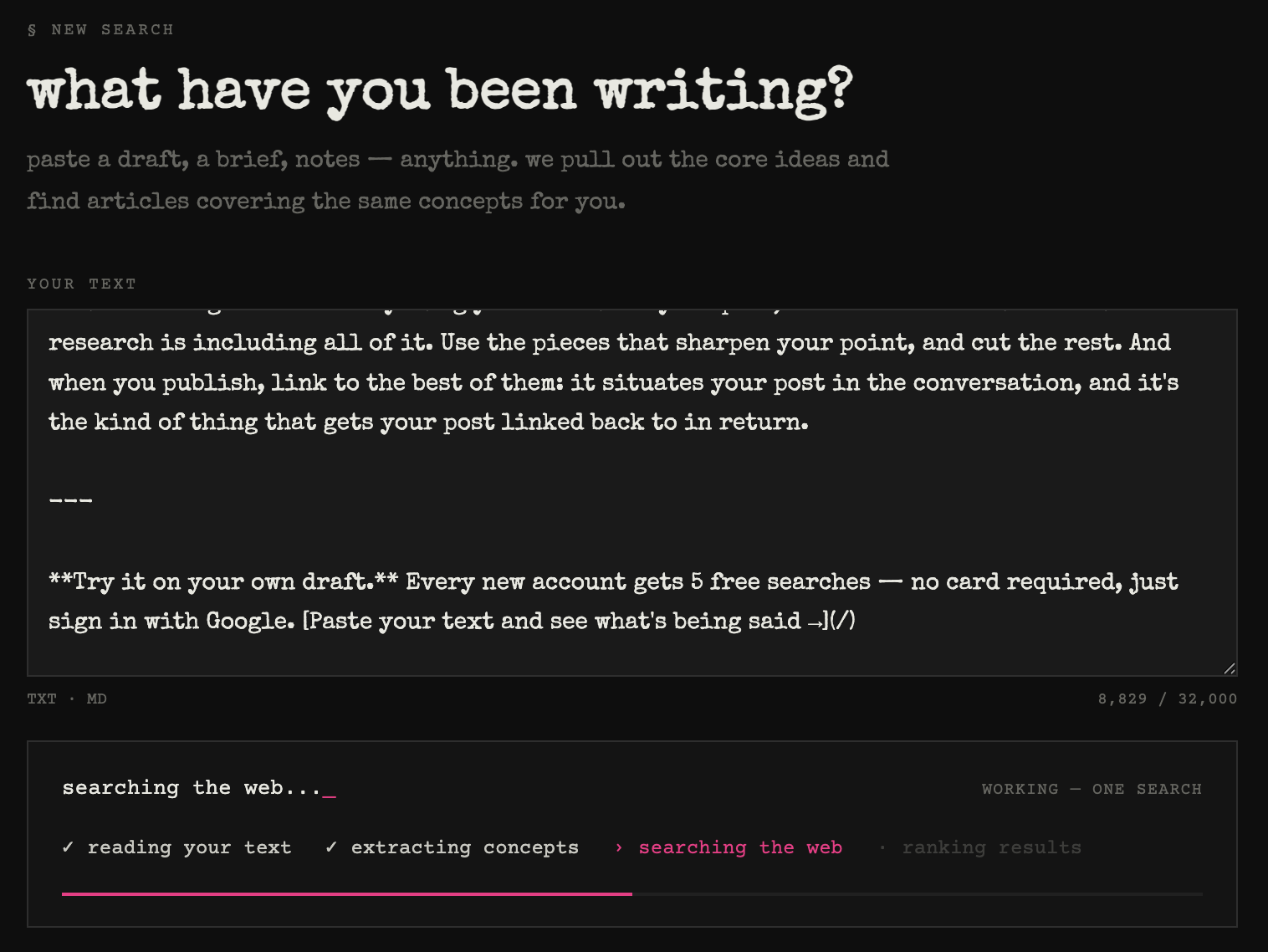
Every idea gets searched and the results get cross-referenced. This is the overlap step from the by-hand version, done exhaustively — every result from every search compared, and articles ranked by how many of your ideas surfaced them. The run takes under a minute.
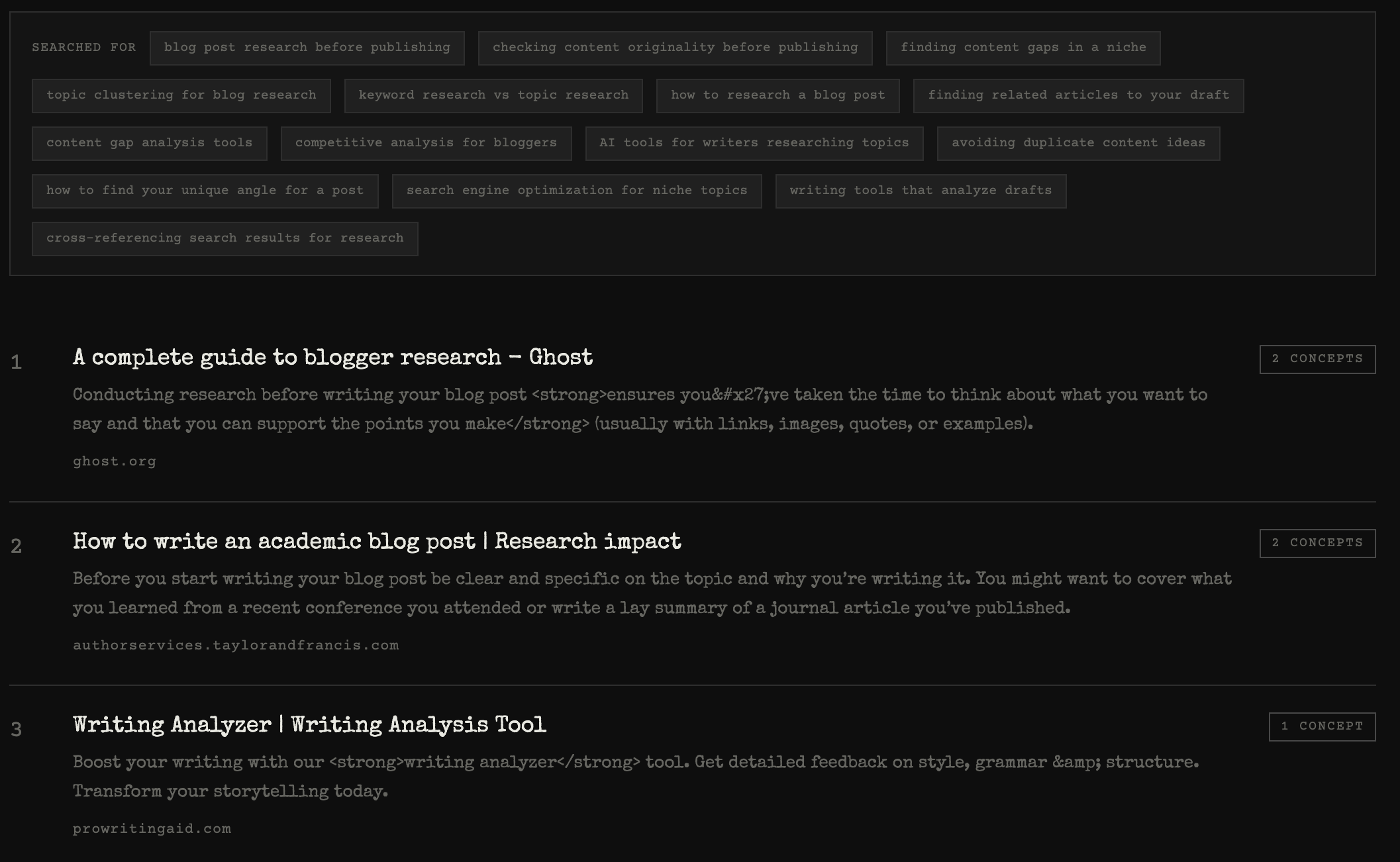
You get the pieces most like yours, ranked. The top results are the posts sitting at the same intersection of ideas as your draft, each showing which and how many of your ideas surfaced it — so you can see at a glance whether anything out there is really covering your exact take. The extracted ideas are listed too, so you can sanity-check what it searched.
Reading the result
A dense cluster of results all matching four or five of your ideas means your exact ground is well-trodden — time to sharpen your angle or find the sub-point nobody's made. A scatter of results that each match only one idea means the opposite: the specific intersection your draft occupies is open, and you can publish knowing you're not the tenth person to say it this week.
There's a bonus signal hiding in that second case. If BeingSaid pulls seven ideas out of your draft and nothing out there matches more than one, the intersection may be genuinely yours — but it can also mean your piece spans topics nobody searches for together, which is worth knowing before you wonder why it gets no traffic. Either way, you've replaced a vague 11pm worry with something you can actually see. (For the fuller version of this research habit, the pillar guide walks through how to find out what's already been written about your topic.)
Then publish. The check was never meant to talk you out of writing — it's meant to let you hit publish without the nagging voice, because this time you actually looked.
Check your draft before you publish it. Every new account gets 5 free searches — no card required, just sign in with Google. Paste your text and see what's being said →